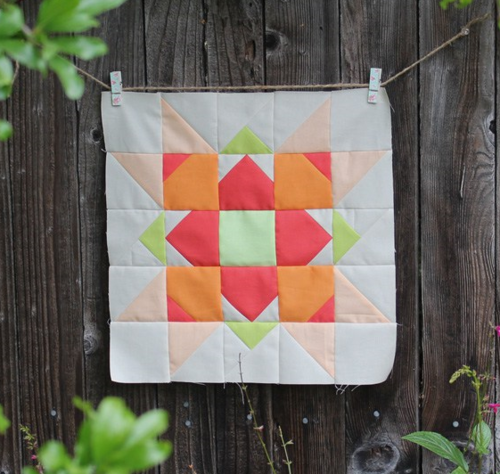
This quilt block actually comes from favquilts.com but it could be used either as a one big clock (for a throw as here) or resized to use in another project with more than one block
Scraps, we all have them, in this video scraps have been used to create an FPP pattern of trees. The quilter has used strips and crumbs to make "fabric" which is then used in place of whole pieces of new cloth to cover the FPP pattern. The resulting quilt is one which will be unique to each maker.
How to make your own FPP pattern for a five pointed hand drawn star. Picture a children's quilt made with multiple of these, both from making more than one pattern but also from turning the pattern to a different orientation.
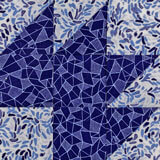
This block could also be called the "disappearing Half Square Triangle" block since you start with a large HST, cut into four strips and rearrange and you have the Delectable Mountains or Buzz Saw quilt block.
If there were a trophy for the most started-least finished quilt it would go to Dear Jane. The quilt itself comes from the Jane Stickle Quilt which is to be found in the Bennington Museum In Vermont and is on display every autumn.
It inspired Brenda Papadakis to write a book called Dear Jane:The Two Hundred and Fifty Five Patterns from the 1863 Jane A Stickle Quilt. and a quilt legend was born.
There are (as the title of the book suggests) 255 blocks and each and every one is different, both in terms of pattern for the pieced blocks but also no coloured fabric is repeated twice. Many of the block designs are unique and would have been of Janes own devising. The centre squares are four inches across and many are made by piecing and applique together.
Although married Jane Stickle had no children of her own and the quilt was constructed whilst her husband was away at war, Jane herself was not in the best of health during this time and yet she managed to construct this beautiful quilt which although of the style of the period was her entirely her won work (in a time when group quilts were popular) and also uses considerably smaller blocks than the norm.
Brenda's book contains drawings of every block in the quilt but no instructions. There are EPP kits that you can buy the papers for ( at several hundred pounds a piece just for the papers), there are also some YouTubers who have started Dear Jane quilt alongs, EQ also includes a Dear Jane supplement to their software (again lots of money to pay out!).
This is a star block that can be varied depending on the number of colours used. It is based upon a 5x5 grid and uses HST's and flying geese (although of course two HIS's back to back make a flying goose)
Patchwork Square does a multicolour version here and includes sample layouts and gives the effect of an isolated star
This block is based on an 8x8 grid which can be broken down into four quadrants. The outside subunits are squares and HST's. The central subunit can either be made from 4 larger HST's or can be a square in a square made from stitch and flip.
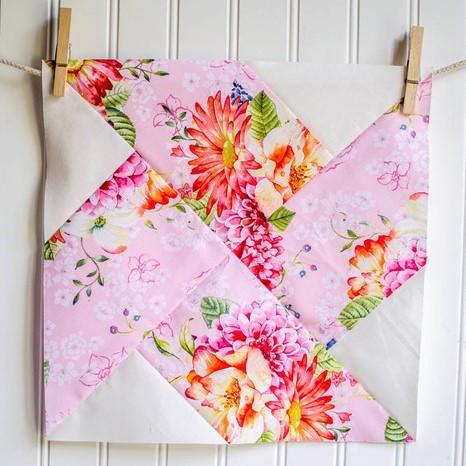
Having featured the O block it seems only fair to feature the X block just in case you want to to XOXO...However note that this block is based on a 2x2 grid not 3x3 so if you want to use it with this O block then use either a 6" or 12" block.
This is not the O block used with the X block to make an x's and o's quilt (which is based on a 2x2 grid) this is a variation of a snowball block based on a 3 x 3 grid - that being said if you want to make an XOXO quilt with this version make the blocks 6" or 12" and they will still fit together.
This version is from Generations Quilt and comes in five sizes
Similar to the Bears Tracks block except there is a cornerstone and sashing within the block itself. The cornerstone can be the same size as the HST subunits (as shown here) or you can vary the block by making it smaller or larger
This version is from Generations Quilt and is in three sizes
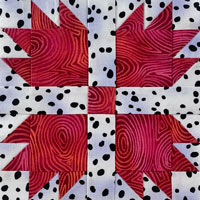
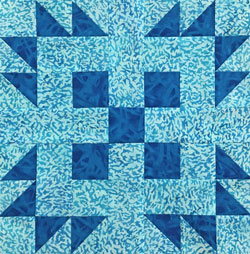
This block is a single paw print or leaf depending on how you look at it and uses whole squares and HST's. You can also see it is a subunit of the larger Bear Paw block
This version is from Generations Quilt and comes in multiple sizes
Other variations use four of the single "paws" and arrange as a four patch
from material girls
from Lisa Capen Quilts
Made by Sue
Quilt Crafters Corner
Riley Blake Designs
Adventures of a DIY Mom includes a stem in their block
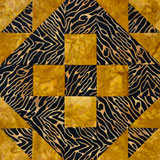
This block is a variation of the bear paw block - not to be confused with the double four patch block which is also called autumn tints. Here the large square for each "paw" is replaced with a four patch which is colour co-ordinated with the sashing and cornerstone within the block to give the appearance of a nine patch.
This version is from Generations quilts and comes in three sizes






:max_bytes(150000):strip_icc():format(webp)/img_1930-scrappylg_1_0-51ed51d4e9154c01864029183c662f09.jpg)


:max_bytes(150000):strip_icc():format(webp)/summer-quiltslg_2-a5246bac12cb4d368fca1d00319dc2f2.jpg)
:max_bytes(150000):strip_icc():format(webp)/101516738_600-c53a101195404a789e9d6d10e12df6a1.jpg)


